To increase SNR for an apertureless SNOM, it is necessary to distinguish the scattered light (signal) produced by the probe from the background light (noise). One method is to place the detector close to the probe apex. A photocantilever is a photosensitive Si-based microfabricated cantilever with a PD placed very close to the probe tip. Figure 1 shows a photograph of a photocantilever (a), and a sketch of that (b). The photocantilever is attached to a piezoelectric transducer (PZT) allowing z distance regulation. The photocantilever is moved close to the sample surface and the distance between the cantilever and the surface is detected from the focus error signal of the optical head placed above the cantilever.
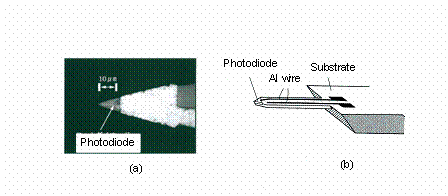
Fig. 1. Photograph of photocantilever, in which top photodiode (PD) is fabricated (a), and sketch of that (b)
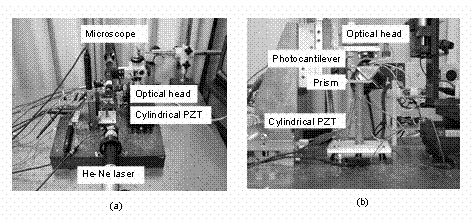
Fig. 2. Photograph of AFM / SNOM setup mounted on a vibration-damped table
 Fig. 3. Sketch of experimental setup. AFM is used for measuring surface
profile and SNOM is used for observing surface property by detecting the
scattered light from the evanescent field
Fig. 3. Sketch of experimental setup. AFM is used for measuring surface
profile and SNOM is used for observing surface property by detecting the
scattered light from the evanescent field
Figure 2 shows a photograph of an AFM / SNOM setup mounted on a vibration-damped table. A He-Ne laser (this side) incident to a prism and a microscope (other side) are used to observe the sample and the cantilever tip, which is helpful in aligning the setup. An evanescent light is produced at the prism surface by the total internal reflection arrangement. The prism is mounted on a cylindrical PZT, allowing xyz movement. The z movement is used for the gap (distance) control and xy for 2-D scanning. Since the piezoelectric transducer has characteristics of creep and hysteresis, it is driven by a small voltage or with feedback control. Figure 5.15 shows a sketch of the main part of the setup using the photocantilever
The photocantilever tip scatters the localized evanescent light changing to a propagating light to be detected by the PD. Since the PD is integrated very close to the tip, the SNR is markedly increased compared with the conventional arrangement used in the PMT method.
A small gap between the cantilever and the
sample surface (displacement of the tip) is detected as the focus error signal
of the optical head. Figure 3 shows a focus error signal representing a typical S-shape curve.
From this S-shape curve, it is found that the dynamic range becomes approximately
29 μm. This optical head’s focus error detection makes the setup simpler
resulting in better manipula bility than that of the combined laser source and quadrant PD arrangement.
Fig. 3. Focus error signal representing typical S-shape curve of optical head
Detection of evanescent light
First, a 7-mW He-Ne laser incident to a prism at an angle of 45°, refracts and goes through the prism and reflects at the upper surface
creating an evanescent light by the total internal reflection. Second, the photocantilever is moved close
to the prism surface with the vibration of its resonance frequency (4.2 kHz) at
an amplitude of approximately 500 nm. The cantilever tip scatters the
evanescent light and the PD close to the tip detects the scattered light. To approach
the tip to the surface in the nanometer range, both manual control (rough
positioning) and piezoelectric control (fine positioning) are required. The
distance between the tip and the sample surface is ob tained by the focus error signal of the optical head.
Fig. 4. Measured evanescent light intensity with cantilever amplitudes of 550 nm (a), 700 nm (b), and 1400 nm (c)
 Fig. 5. Dependence of measured evanescent field intensity on distance from
boundary. Theoretical result is also shown for reference
Fig. 5. Dependence of measured evanescent field intensity on distance from
boundary. Theoretical result is also shown for reference
Figure 4 shows the evanescent light intensity with the cantilever amplitude of 550 nm (a), 700 nm (b), and 1400 nm (c). An FFT low-pass filter is used to remove noises resulting in solid lines in the figure. In the cases of (b) and (c), a flat signal region appears during the period when the cantilever tip reaches the prism surface owing to a large vibration amplitude.
Simultaneous light and gap (distance) observations lead to the evanescent
field intensity distribution as shown “experimental” in Fig. 5. It is
found from the figure that the evanescent intensity increases rapidly when
the gap reaches approximately 100 nm.